
Skip to content
TechDev AcademyTechDev Academy
  • HOME
  • MENTORSHIP
  • ENTREPRENEURSHIP
  • ELITE COLLEGE PREP
  • OLYMPIAD
  • CONTACT US
TechDev AcademyTechDev Academy
  • HOME
  • MENTORSHIP
  • ENTREPRENEURSHIP
  • ELITE COLLEGE PREP
  • OLYMPIAD
  • CONTACT US
Entrepreneurship

3 Essential Mindset Shifts for First-Time Entrepreneurs

  • 31 Jul, 2025
  • Com 0

Many people believe starting a business is all about finding one great idea. The truth is, a brilliant concept is not enough to guarantee success. Your ability to fundamentally change your thinking is what truly matters. Moving from founder to leader requires specific mental adjustments to build resilience and take disciplined action.

This guide breaks down the three most essential mindset shifts for first-time entrepreneurs. You will learn how to overcome the fear that leads to inaction and see failure as a strategic tool instead of a personal defeat. We will also cover how to build consistent discipline so you no longer have to rely on motivation. Mastering these changes will help you navigate the challenges of building a business from the start.

From Idea to Execution: Overcoming Fear

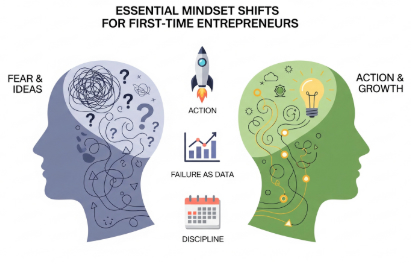
The first step in your journey is often the hardest. Inaction rarely comes from a lack of good ideas but from a powerful and interconnected web of fears. To move forward, you must first understand the mental barriers holding you back. These fears create a self-reinforcing system composed of three main parts.

First is the fear of failure. This is not just about the potential for financial loss. It is a complex fear tied to your social identity and personal worth. You may worry about being judged or labeled a “failure,” which can feel devastating to your self-esteem. This anxiety often causes you to fuse your sense of self with your business’s performance. This makes any setback feel like a personal indictment of your intelligence. As a result, many founders turn to perfectionism and over-planning as defense mechanisms to avoid the judgment that comes with launching.

Next is the fear of the unknown. Your brain is wired to seek certainty and recognize patterns to keep you safe. Entrepreneurship is a direct challenge to this need for predictability. This journey into uncharted territory can trigger a stress response that leads to paralyzing anxiety. This fear is not about a specific negative outcome but rather the simple absence of a clear path forward, which your brain interprets as a threat.

Finally, imposter syndrome completes the cycle. This is the internalized fear that you will be exposed as a “fraud,” even if you have evidence of your skills and competence. You might attribute your successes to luck or timing rather than your own abilities. This is especially common for entrepreneurs, who often operate without the validation of a traditional corporate structure. These three fears feed each other, but taking decisive action can break the loop by generating real-world data and tangible proof of your competence.
Mindset for young student

Practical Techniques to Beat Analysis Paralysis

The most effective way to counter these fears is to shift your mindset from seeking perfection to generating momentum. Your ideas have little value until you act on them. Execution is what creates a real business and is the true intellectual property that determines success. By adopting a “progress over perfection” mindset, you understand that an 80% solution that launches is far more valuable than a 99% solution that never sees the light of day.

Here are a few practical tools to help you put this mindset into action.

  • Use the “Two-Way Door” Framework. Pioneered by Amazon’s Jeff Bezos, this mental model helps you make decisions faster by categorizing them. “One-way doors” are irreversible decisions with major consequences, and you should make them slowly and carefully. “Two-way doors,” however, are reversible. If you make a mistake with a new pricing test or marketing channel, you can always go back. The key is recognizing that most of your decisions are two-way doors, which empowers you to act quickly and gather data without unnecessary delay.
  • Make Your Deadlines Real. Parkinson’s Law states that work expands to fill the time available for its completion. While deadlines create urgency, a self-imposed or “fake” deadline often fails because you know there are no real consequences for missing it. To give your deadlines teeth, you can either externalize accountability by committing to your deadline with a mentor or peer group or clearly articulate the negative chain of events that will occur if you miss it. This reframes the deadline as a critical link in your progress.
  • Launch a Minimum Viable Product (MVP). An MVP is a core concept of the Lean Startup methodology and a practical way to force action. It is the version of your product that lets you collect the maximum amount of validated customer learning with the least amount of effort. Instead of building a full-featured product based on assumptions, you build only the core features needed to solve a key customer problem. Releasing this minimalist version to early adopters provides invaluable feedback and prevents you from wasting resources on something nobody wants. 

Embracing Failure as a Growth Tool

One of the toughest but most important changes you can make is how you think about failure. In most jobs, failure is an endpoint to avoid. As a founder, it must become a process and a valuable source of data that fuels your growth. This requires you to see setbacks not as a reflection of your worth but as impersonal information that can guide your next steps.

The framework for this change comes from Stanford psychologist Carol Dweck’s research on the “Growth Mindset”. According to Dweck, people have one of two views about their abilities:

  • A Fixed Mindset is the belief that your talents are innate and cannot be changed. From this perspective, any failure feels like a final verdict on your limited capabilities.
  • A Growth Mindset is the belief that you can develop your abilities through effort and learning. This view turns failure into an opportunity to improve.

Adopting a growth mindset allows you to depersonalize failure. It helps you create psychological distance between your identity and the results of your business. This changes your thinking from “I am a failure” to “This strategy failed; let’s find out why.” This simple shift converts a painful emotional experience into an objective problem you can analyze and solve.

💼 ➜ 🚀 From Employee to Owner
Stop thinking task-based, start thinking vision-based.
You’re not working for someone — you ARE the business now.
📝 ➜ 🎯 From Perfection to Progress
Focus on launching, then refining — not launching perfectly.
Action beats perfection every time.
🐺 ➜ 🧑‍🤝‍🧑 From Lone Wolf to Networker
Build connections, mentors, and collaborators.
Your network is your unfair advantage.

Real-Life Entrepreneur Stories

The best way to understand the power of a growth mindset is to look at real-world examples of founders who turned significant failures into success.

  • The Scientist: James Dyson. His journey to create the world’s first bagless vacuum cleaner is a masterclass in learning from failure. Over five years, he created 5,127 prototypes before perfecting his design. This was a bootstrapping effort, financed by taking on personal debt while relying on his wife’s teaching salary. The lesson is not about blind persistence but methodical experimentation. Dyson changed only one thing at a time, ensuring that each of the 5,126 “failures” was actually a successful experiment that provided a critical data point.
  • The Evangelist: Colonel Sanders. The story of Harland “Colonel” Sanders is about resilience in the face of constant market rejection. He began trying to franchise his fried chicken recipe at age 65, with his only income being a $105 monthly social security check. He was rejected an estimated 1,009 times before securing his first franchise partner. The lesson from Sanders is the power of unwavering belief in your product’s value and the refusal to see rejection as a final verdict.
  • The Strategist: Reid Hoffman. Before co-founding LinkedIn, Reid Hoffman launched his first startup, SocialNet. The venture failed, not due to a bad concept, but because of poor market timing and a flawed approach of trying to build a “perfect vision” instead of launching a simpler product to gather feedback. Hoffman’s key lesson was that “learning fast” is more valuable than the popular mantra of “failing fast”. The deep, strategic lessons he learned directly informed his later successes at PayPal and LinkedIn. 

Building Self-Discipline and Routine

A common trap for new entrepreneurs is relying on motivation. While passion is a great catalyst for starting a business, it is not enough to sustain you through the inevitable challenges and slow periods. Sustainable success is not built on emotion but on the solid bedrock of internal discipline, which is a system you create through deliberate routines and habits. The crucial mindset shift is to treat progress as a non-negotiable result of your systems, not your feelings.

Self-discipline is not a personality trait you either have or you don’t. It is a skill, like a muscle, that you can develop and strengthen through consistent practice. This process starts with setting small, manageable, and achievable goals. A traditional job provides an external framework for motivation, including bosses and deadlines. The entrepreneurial journey requires you to shift from this external system to an internal one, where you become your own manager. This internal drive is what carries you forward when inspiration fades, which is critical when moving from a structured job or a side hustle into full-time entrepreneurship.

Routines are the blueprints for discipline. Far from being restrictive, they are strategic tools that optimize your performance and conserve your most valuable resource, mental energy. They are a powerful defense against decision fatigue, which is the depletion of your willpower from making too many choices throughout the day. By automating recurring, low-impact decisions like what to wear or eat, you preserve your peak mental energy for the high-stakes problems that actually move your business forward. A consistent routine also builds a “flywheel” effect, where momentum from one habit makes it easier to start the next, reducing your reliance on conscious effort.

Measuring the Impact of Mentorship Programs in SchoolsMorning Habits That Boost Productivity

The development of discipline is anchored in specific actions. Here are some actionable entrepreneur mindset tips that successful founders commonly use to structure their days for peak performance.

  • The “First Hour” Protocol. How you begin your day has a disproportionate impact on your productivity. The goal of the first hour is to be proactive, not reactive to external demands. This includes waking up at a consistent time to regulate your body’s internal clock and drinking a glass of water immediately to rehydrate your brain. A critical discipline is to enforce a strict no phone or email rule for the first hour, which prevents your agenda from being immediately hijacked by the priorities of others.
  • Mind and Body Priming. These habits prepare your physical and mental state for the day’s challenges. Even a short period of physical exercise in the morning can significantly boost energy, improve mood, and sharpen focus for hours afterward. Practices like mindfulness, meditation, or journaling help cultivate mental clarity, reduce stress, and organize your thoughts before the workday begins.
  • “Eating the Frog”. This productivity principle dictates that you should identify your most important and challenging task of the day (the “frog”) and tackle it first thing in the morning. This strategy is effective because it leverages your peak willpower and cognitive energy, which are typically highest in the morning. Accomplishing your most difficult task first creates a powerful psychological win and builds momentum that makes all subsequent tasks feel easier by comparison.

Conclusion

Your success as an entrepreneur is not predetermined by your starting idea or personality. It is forged by the conscious decision to adopt a new way of thinking. By shifting from perfection to action, learning to see failure as invaluable data, and building discipline to override fleeting motivation, you create the psychological foundation for success. These mindsets are learnable skills that give you control over your own entrepreneurial journey. To further strengthen your mindset, learn about the 5 phases of entrepreneurship that every innovator go through.

Frequently Asked Questions

What mindset shifts matter most early in entrepreneurship? 

The most critical early mindset shifts are moving from fear to decisive action. Another key shift is reframing failure as an impersonal source of data instead of a personal verdict. Finally, you must shift from relying on motivation to building the discipline that ensures steady progress.

How do successful founders handle failure? 

Successful founders handle failure by actively depersonalizing the event. They treat setbacks as objective data points that provide clear signals about a specific strategy or assumption. 

Can routine improve startup success? 

A consistent routine can significantly improve the probability of startup success. Routines are a strategic tool for reducing decision fatigue, which conserves your finite mental energy for high-stakes, critical thinking.

How to stay motivated during tough times? 

The most effective strategy is to rely on discipline when motivation naturally fades, using pre-established habits to maintain progress. You can also actively bolster motivation by frequently reconnecting with your core purpose or “why”.

Are certain personality traits better suited for entrepreneurship? 

While research shows a correlation between certain traits and becoming an entrepreneur, learnable skills are more critical than personality. The mindset shifts detailed in this guide are the active ingredients that ultimately determine success, and these skills can be honed regardless of your starting personality type.

Share on:
How Bootstrapped Startups Can Scale Without Venture Capital
Are online casinos legal in Australia

Search

Latest Posts

  • Youth Mentoring Programs: Models, Benefits, and How to Choose the Right One
  • The Future of Jobs: Top Skills You Actually Need in 2030
  • Should Every Child Learn Coding? A Realistic Look at Programming for Kids
  • The Ultimate Competitive Advantage: Why Kids Need a Growth Mindset
  • Beyond the Screen: What Technological Literacy for Kids Actually Means in 2026

Categories

  • Blog (1)
  • Career (9)
  • Coding (18)
  • College Application (27)
  • College Preparation (16)
  • Entrepreneurship (28)
  • Learning (17)
  • Mentoring (4)
  • Mentorship (14)
  • Parenting (10)
  • Programming (11)
tech-dev.png

228 Hamilton Avenue, Palo Alto, CA 94301
[email protected]

Quick Links

  • HOME
  • MENTORSHIP
  • ENTREPRENEURSHIP
  • ELITE COLLEGE PREP
  • OLYMPIAD
  • BLOG
  • CONTACT US

Contact

Enter your email address to register to our newsletter subscription

Icon-facebook Icon-linkedin2 Icon-instagram Icon-twitter Icon-youtube
Copyright 2026 . All Rights Reserved
TechDev AcademyTechDev Academy
Sign inSign up

Sign in

Don’t have an account? Sign up
Lost your password?

Sign up

Already have an account? Sign in