We often mistake a child’s ability to navigate an iPad for being “tech-savvy.” However, in today’s rapidly evolving landscape, technological literacy for kids goes far beyond knowing how to use an app. In fact, it is the fundamental understanding of how technology is created, how it functions, and how it shapes our society.
Furthermore, in the age of generative AI, being a passive user is a disadvantage. Consequently, true literacy is about moving from the passenger seat to the driver’s seat of the digital revolution.
Technological Literacy vs. Digital Literacy: What’s the Difference?
Many parents ask: “Isn’t my kid already tech-literate because they use YouTube?” To clarify, it’s important to distinguish between these two concepts:
-
Digital Literacy: The ability to find, evaluate, and communicate information using digital platforms (e.g., searching Google, using Zoom, or spotting a fake news headline).
-
Technological Literacy: A deeper, more “under-the-hood” capability. Specifically, it involves understanding the logic of algorithms, the mechanics of hardware, and the ability to build or modify tools.
Moreover, while digital literacy is about using the world as it is, technological literacy is about reimagining it through Entrepreneurship and innovation.
Why “Digital Native” is a Dangerous Myth
The term “digital native” suggests that kids born into a world of screens instinctively understand them. Nevertheless, this is a myth. On the contrary, without intentional guidance, kids become passive consumers—expert users of interfaces designed to be addictive, but completely unaware of the “black box” logic behind them.
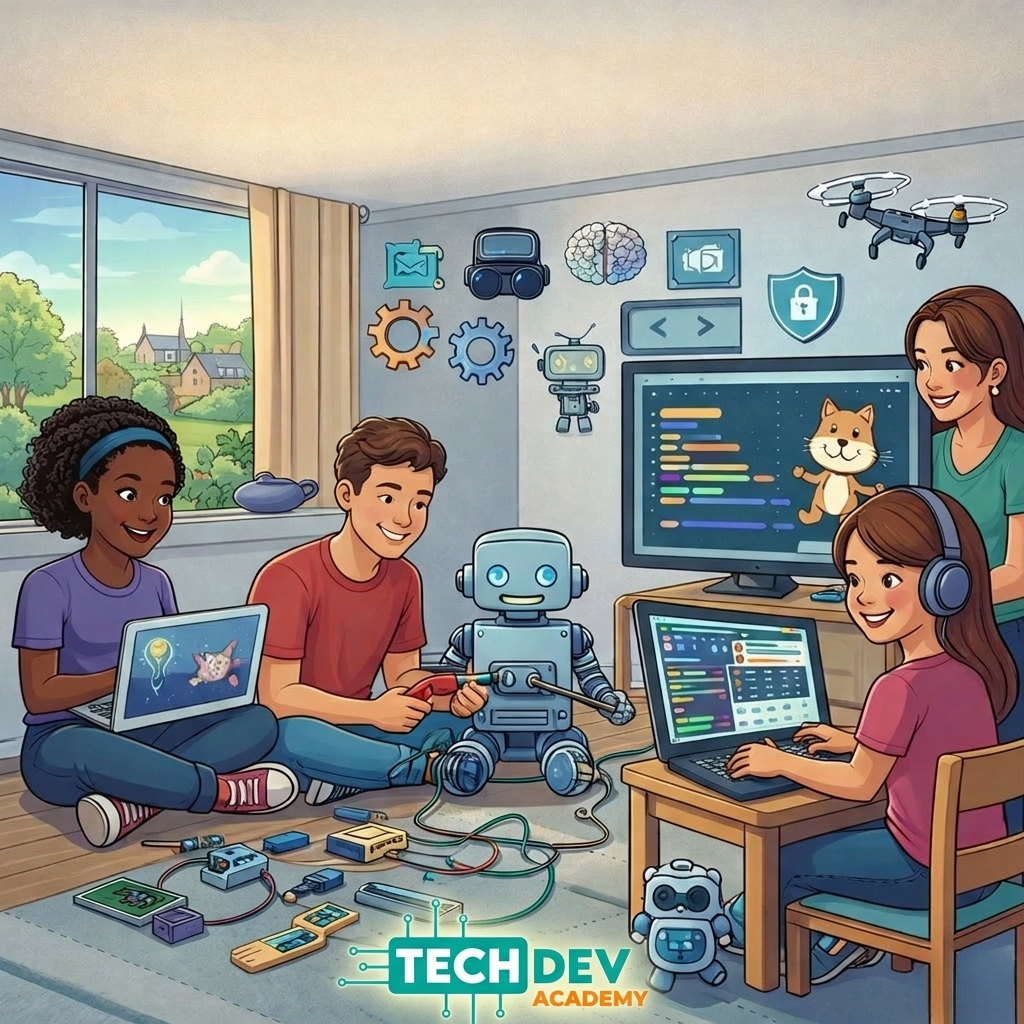
As a result, at TechDev Academy, we believe that if a child doesn’t understand the tool, the tool ends up “using” the child. Therefore, by teaching coding for kids and AI fundamentals, we empower them to break out of these pre-defined playpens.
The AI Shift: Critical Skills for the 2026 Landscape
For instance, in 2020, tech literacy was about knowing how to code a basic website. In contrast, in 2026, it’s about AI Orchestration. A technologically literate child today must master:
-
Prompt Engineering & Synthesis: Knowing how to communicate with AI to get high-quality results.
-
Algorithmic Bias Awareness: Recognizing that AI models are trained on human data and can carry human prejudices.
-
The “Yet” Mindset: Understanding that in technology, failure is just a “bug” that hasn’t been fixed yet. (Read more about building a Growth Mindset here).
3 Practical Ways to Foster Technological Literacy at Home
First, demystify the “magic” with real examples. When Netflix recommends a movie, ask your child: “How did the algorithm know you liked that? What data points did it collect?” By doing so, you transform a passive experience into a lesson in data science.
Second, move from consumption to creation. Specifically, set a “Creator Ratio.” For every hour of gaming, encourage 30 minutes of building. Whether it’s creating a level in Roblox or a simple script in our Mentorship Program, the shift from “player” to “developer” is where true literacy begins.
Third, embrace “productive struggle.” When a child encounters a tech glitch, don’t fix it for them. Instead, encourage them to “debug.” Indeed, research shows that the process of troubleshooting builds neural pathways that are essential for high-level engineering and problem-solving.
The Economic Reality: Technological Literacy as Insurance
Ultimately, the future job market won’t just require “computer skills”—it will require learning agility. Thus, a child who understands the underlying principles of technology can adapt when one tool (like ChatGPT) is replaced by the next.
In conclusion, by investing in technological literacy for kids early, you aren’t just preparing them for a career in Big Tech. Rather, you are giving them the tools to be leaders in any field, from medicine to law.