

Last updated: July 2026 · 12 min read · Written by TechDev Academy Team
Most high school students who enter a startup competition spend weeks perfecting their idea and almost no time preparing their pitch. They show up on competition day with a product they love and a presentation that falls apart under the first tough question.
The students who win are not always the ones with the best ideas. They are the ones who did the preparation most students skip.
📌 Quick Answer
Preparing for a startup competition in high school requires more than a great idea. Students need to validate the problem with real customers, research the market with data, build a simple business model, create a clear pitch deck, practice answering judge questions out loud, and get honest feedback before competition day. Most entries lose in the Q&A — not the pitch itself.
In This Article
- What Do Judges Actually Look For?
- What Do Judges Notice in the First 30 Seconds?
- Step 1: How Do You Validate Your Problem Before the Competition?
- Step 2: How Do You Research Your Market Like a Judge Would?
- Step 3: Why Do You Need a Business Model, Not Just an Idea?
- Step 4: How Do You Build a Pitch Deck That Tells a Story?
- Step 5: How Do You Practice a Pitch Until It Actually Works?
- Step 6: How Do You Prepare for Tough Questions From Judges?
- Step 7: Why Is Getting Expert Feedback the Most Important Step?
- What Does a Startup Competition Preparation Timeline Look Like?
- What Mistakes Instantly Reduce Your Score?
- What Should You Bring on Competition Day?
- What Should You Do Immediately After Your Pitch?
- What Should Be on Your Startup Competition Checklist?
- People Also Ask
What Do Judges at Startup Competitions Actually Look For?
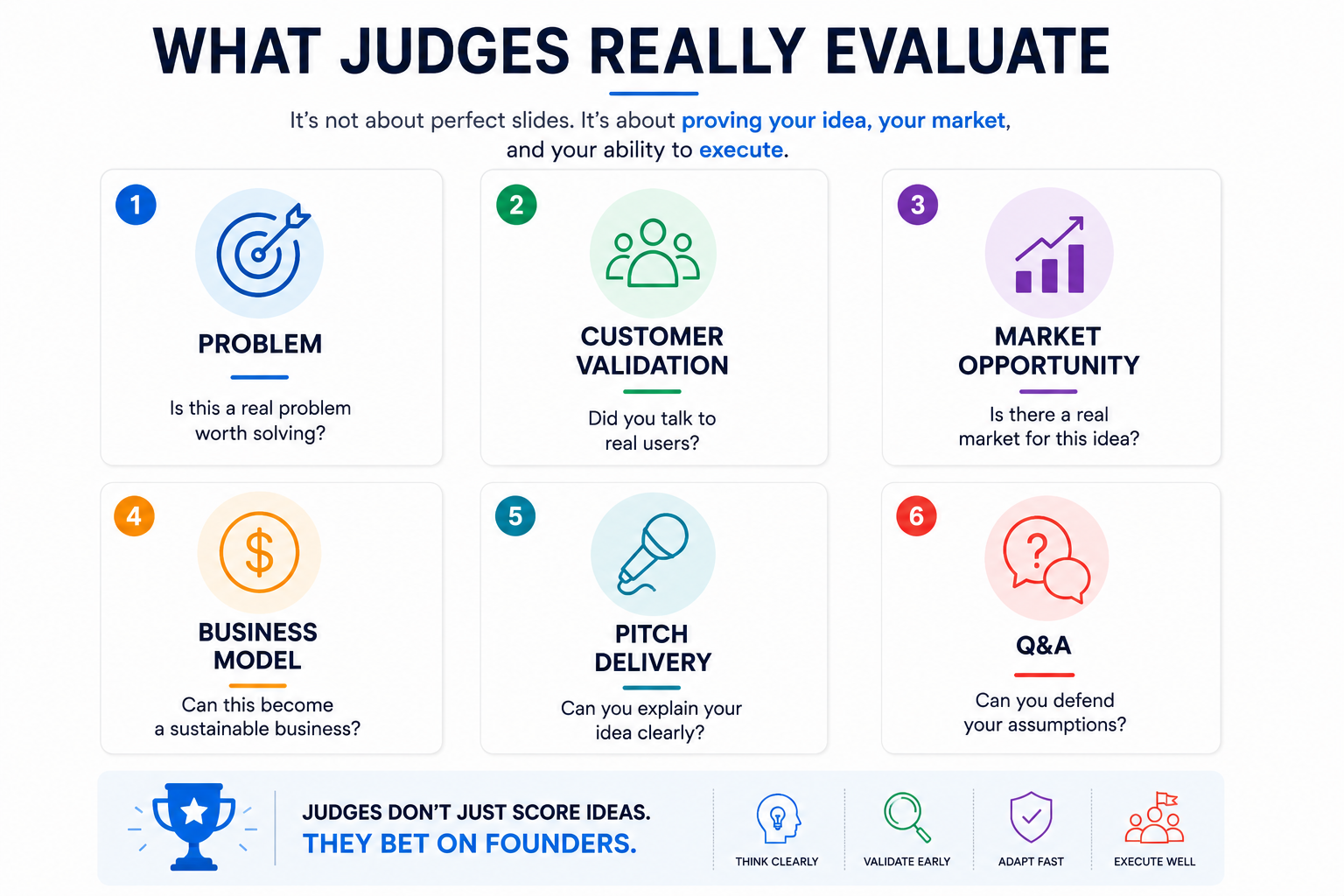
Before you prepare anything, understand what gets scored. Most students prepare for the wrong things.
Judges at startup competitions — whether at Junior Achievement, DECA, or investor pitch events — consistently reward students who can explain their market clearly and defend their assumptions under questioning. A well-researched idea with a clear pitch beats a technically impressive product with a confusing story — every time.
| What Judges Want to See | What Most Students Actually Show |
|---|---|
| A specific, validated problem | A vague frustration they personally experienced |
| A customer they have spoken to | An assumption about who might buy it |
| A realistic business model | A product with no revenue plan |
| A confident, natural pitch | A memorized script that falls apart under pressure |
| Honest self-awareness | Defensive answers when challenged |
The Q&A is where most entries fail. Prepare for it more than anything else on this list.
What Do Judges Notice in the First 30 Seconds?
Before you say a word, judges are already forming an impression.
- Confidence when you walk in. Students who look nervous before they start are already at a disadvantage.
- How you open. A surprising statistic, a specific customer story, or a bold claim signals that you know how to communicate.
- Whether you look at the judges or your slides. Looking at your slides means you are not ready.
- Your first sentence. If it does not name a specific problem, judges immediately wonder if you understand what you are pitching.
💡 Pro Tip: Open with a customer story, not a mission statement. “Last year, Maria spent 40 hours trying to find a tutor for her AP Chemistry exam and still failed the test” is more compelling than “We are building a tutoring marketplace.”
Step 1: How Do You Validate Your Problem Before the Competition?
Why This Matters
One of the most common reasons startup competition entries fall short is not a bad solution. It is a solution to a problem that does not matter enough to anyone.
Airbnb’s founders did not assume people wanted to rent space in strangers’ homes — they tested it themselves first. Dropbox’s founder did not build the product before validating demand — he posted a demo video and measured signups. That is what validation looks like in practice.
Common Mistake
⚠️ Students interview friends and family. Friends tell you what you want to hear. That is not market research — it is confirmation bias with extra steps.
How to Validate Your Problem
- Talk to at least 10 people who match your target customer — not people who know you
- Ask them to describe the problem in their own words before you mention your solution
- Find out how they currently deal with it and what frustrates them most
- Ask if they would pay for something better — and how much
- Look for patterns across multiple conversations, not just one or two responses
💡 Pro Tip: Record every customer conversation with permission. Write down exact quotes. “17 of the 23 students we spoke to said they spend over 3 hours per week on this problem” is ten times more convincing than “we believe our target market faces this challenge.”
Action Checklist
- Identify your target customer profile specifically
- Complete 10 customer interviews with non-family members
- Document recurring patterns and exact quotes
- Update your problem statement based on what you actually heard
Step 2: How Do You Research Your Market Like a Judge Would?
Why This Matters
Market questions expose whether you have done real research or invented numbers that sound impressive. Poor market understanding is consistently one of the top factors in early-stage startup failure — and judges know this.
Common Mistake
⚠️ Students say “there is no competition.” Judges hear this as “I have not done enough research.” Every real problem has existing solutions — even imperfect ones. Showing that you understand your competitors and can explain why your approach is better is far stronger than claiming the space is empty.
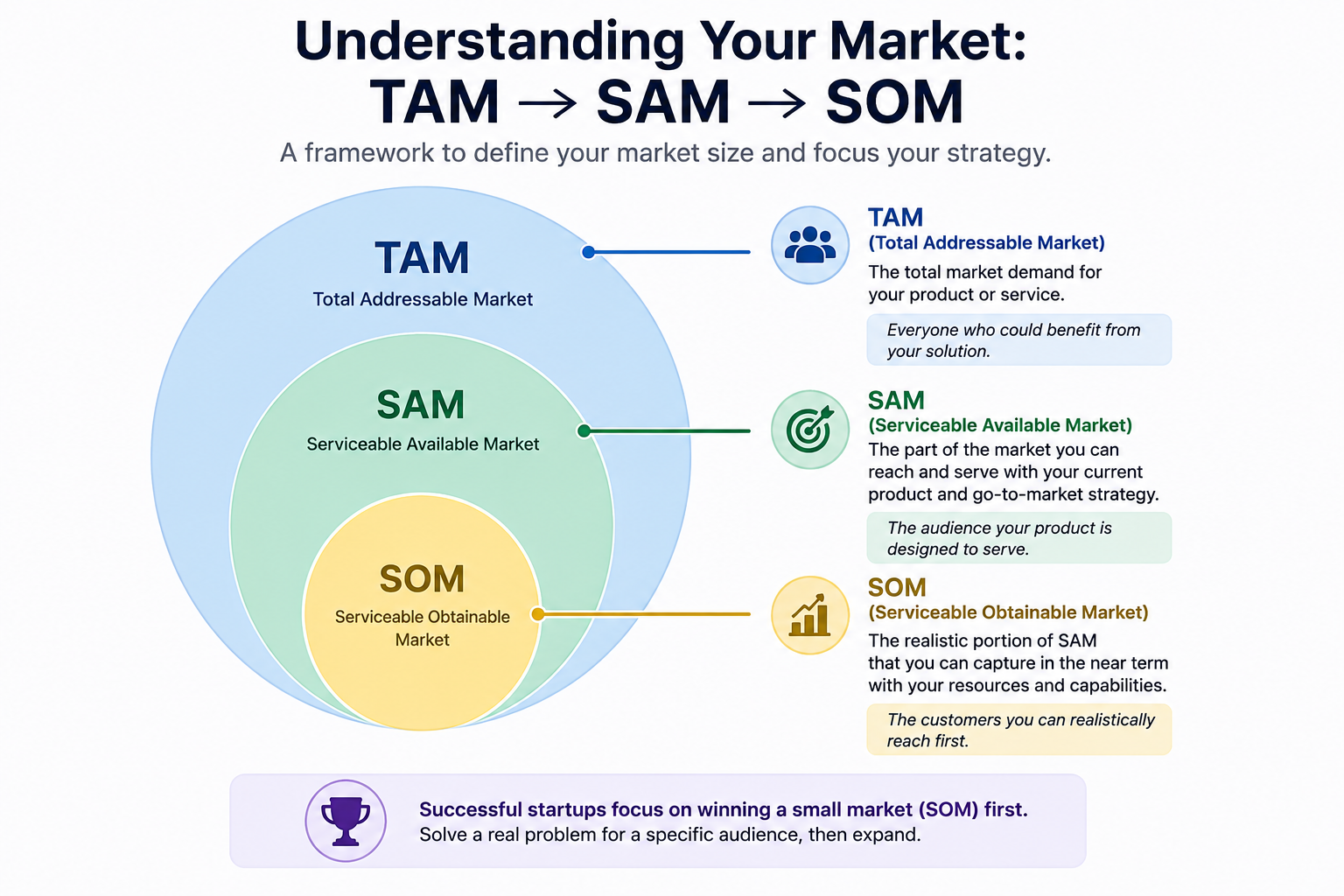
TAM SAM SOM — What They Mean and Why Judges Care
| Term | What It Means | Example |
|---|---|---|
| TAM | Total market if you captured everyone | All US high schoolers using study apps |
| SAM | Portion you could realistically reach | High schoolers in California with smartphones |
| SOM | What you could capture in year one | Bay Area students you can reach directly |
Judges do not expect perfect numbers. They expect honest numbers with a clear source. “Based on Census data, there are 15 million high school students in the US, and our interviews suggest 30% face this problem” is far stronger than “$10 billion market opportunity” with no methodology behind it.
Competitive Analysis
Map your competitors honestly. Show where they fall short — and why your solution is meaningfully different. A simple competitor matrix with three to five alternatives and a clear differentiation column takes 30 minutes to build and consistently impresses judges.
💡 Pro Tip: Use Google Trends, Statista, IBISWorld, or government census data for market size. Citing a real source signals that you know how to research, not just how to Google.
Action Checklist
- Calculate TAM, SAM, SOM with cited sources
- Identify at least 5 competitors and their weaknesses
- Build a competitor matrix showing your differentiation
- Prepare to explain your market size methodology out loud
Step 3: Why Do You Need a Business Model, Not Just an Idea?
Why This Matters
A product idea answers what you are building. A business model answers how it makes money and survives. According to CB Insights, 38% of startups fail because they run out of cash — not because their idea was bad. Most of them had good products. What they lacked was a clear model for how money would actually flow in and out.
Common Mistake
⚠️ Students say “we will make money through subscriptions” with no numbers attached. That is not a business model. That is a sentence. Judges want to see a price point, a target number of customers, and a basic revenue projection.
The Key Elements
| Element | Question It Answers |
|---|---|
| Revenue Streams | How exactly does money come in? |
| Customer Segments | Who is paying, specifically? |
| Channels | How do you reach and acquire customers? |
| Cost Structure | What are your main costs? |
| Key Partners | Who do you need to deliver your solution? |
💡 Pro Tip: A simple, believable business model beats a complex one every time. If you cannot explain how your business makes money in two sentences, keep simplifying until you can. Judges are not impressed by complexity — they are impressed by clarity.
Action Checklist
- Define your primary revenue stream with a specific price point
- Calculate a basic year-one revenue projection
- Identify your top three costs
- Explain your model in two sentences without jargon
Step 4: How Do You Build a Pitch Deck That Tells a Story?
Why This Matters
Your pitch deck is not a document. It is a visual aid for a story you are telling out loud. When visuals support what you say rather than repeat it, audiences follow your argument more easily and remember it longer. Your slides should carry the data; your voice should carry the story.
Common Mistake
⚠️ Students put too much text on slides and then read from them. If a judge can read every word on your slide while you are talking, your slide has too much text. This also signals that you have not internalized your own content.
The 8-Slide Structure That Works
- Slide 1 — The Problem: One sentence. One specific, real problem. No jargon.
- Slide 2 — The Solution: What you are building and why it works better than alternatives
- Slide 3 — The Market: TAM/SAM/SOM with sources
- Slide 4 — The Business Model: How you make money
- Slide 5 — The Competition: Who else is in this space and your clear differentiation
- Slide 6 — The Traction: Any early evidence — surveys, pilots, signups, prototypes
- Slide 7 — The Team: Why you are the right people to build this
- Slide 8 — The Ask: What you need and specifically what you will do with it
Weak vs Strong Pitch Deck
| Weak Slide | Strong Slide |
|---|---|
| “Our market is huge and growing” | “$4.2B market, 12% YoY growth (IBISWorld 2025)” |
| “We have no real competitors” | Competitor matrix with 5 alternatives and clear differentiation |
| “We will make money through subscriptions” | “$9/month, targeting 500 users in year one = $54K ARR” |
| “We are passionate about this problem” | “We interviewed 23 potential customers. 18 said they would pay.” |
💡 Pro Tip: Use one visual per slide — a chart, a diagram, or a single bold statistic. The words come from your mouth, not your slides.
Action Checklist
- Maximum 8 slides with one clear point each
- No paragraph text on any slide
- All numbers have cited sources
- Traction slide includes real evidence, not projections
Step 5: How Do You Practice a Pitch Until It Actually Works?
Why This Matters
Most students practice by reading their script a few times. Then they sound robotic on competition day. The students who win practice in a fundamentally different way — and they start at least two weeks before the competition, not the night before.
Common Mistake
⚠️ Students practice alone in their room. Practicing without an audience means you never experience the pressure of being watched, interrupted, or asked a question you did not prepare for.
Three Practice Methods That Actually Work
1. Record yourself on video.
Watch it back. This is uncomfortable — which is exactly why most students avoid it and why the ones who do it improve fastest. Watch for filler words, pacing, eye contact, and whether your explanation makes sense to someone hearing it for the first time.
2. Practice in front of people who will give honest feedback.
Not people who will say it was great. Ask them to interrupt you mid-pitch with questions, because that is exactly what judges do.
3. Time yourself precisely.
Most competitions allow 5 to 10 minutes for the pitch. Going over time signals poor preparation. Know your exact timing before competition day.
💡 Pro Tip: Do at least one full dress rehearsal — standing up, slides running, in front of at least three people — exactly as you will present on competition day. Familiarity with the physical experience reduces nerves significantly.
Action Checklist
- Recorded yourself at least 3 times and watched the footage
- Practiced in front of at least 3 people who gave honest feedback
- Timed precisely — within 30 seconds of your competition limit
- Practiced being interrupted with questions mid-pitch
Step 6: How Do You Prepare for Tough Questions From Judges?
Why This Matters
The Q&A is where most high school startup competition entries collapse. Many startup competitions place significant emphasis on the Q&A because it tests your understanding of the business — not just your presentation skills. Judges use it to find out how deeply you actually know your idea.
Common Mistake
⚠️ Students prepare answers for the questions they hope to get. Judges ask the questions you hope they will not.
Judge Questions — Weak vs Strong Answers
| Judge Question | Weak Answer | Strong Answer | Why the Strong Answer Wins |
|---|---|---|---|
| “Who is your customer and have you talked to them?” | “Our target market is teenagers” | “We interviewed 15 students aged 14-17 in Bay Area schools. Here is what they told us.” | Specific evidence beats general claims |
| “What if a bigger company copies your idea?” | “We will move faster than them” | “Our advantage is [specific moat]. It would take a larger company 18+ months to replicate because…” | Shows strategic thinking, not wishful thinking |
| “What is your biggest weakness right now?” | “We are still figuring out distribution” | “Our biggest gap is [specific thing]. Here is our 90-day plan to address it.” | Honest self-awareness with a plan impresses judges |
| “Why are you the right team?” | “We are passionate about this” | “Between us we have [specific skills]. We have already [specific proof of execution].” | Passion without evidence means nothing |
| “How did you arrive at your market size?” | “We read that this market is huge” | “We used Census data and our own customer interviews. Here is the methodology.” | Shows research discipline |
💡 Pro Tip: The best answer to a question you do not know is: “That is a great question and honestly we have not fully solved it yet. Here is how we are thinking about it.” Judges respect intellectual honesty far more than confident-sounding deflection.
Action Checklist
- Written answers for at least 15 common judge questions
- Practiced being asked questions mid-pitch
- Identified your three biggest weaknesses and prepared honest answers
- Practiced saying “I don’t know, but here is how I would find out”
Step 7: Why Is Getting Expert Feedback the Most Important Step?
Why This Matters
Everything in the previous six steps can be done independently. The single biggest competitive advantage is direct feedback from someone who has built a company or judged these competitions before.
Experienced founders see problems with your pitch that you cannot see yourself — because you are too close to your own idea. They know what judges are looking for because they have been on both sides of the table.
Common Mistake
⚠️ Students ask teachers or parents for feedback. Teachers know education. Parents know you. Neither knows what a startup competition judge is actually looking for.
💡 Pro Tip: One hour with someone who has competed in or judged a startup competition is worth more than ten hours of self-preparation.
Action Checklist
- Identified at least one person with real startup or competition experience
- Completed at least one full mock pitch with that person
- Applied their feedback before your next practice run
- Scheduled a final feedback session at least 3 days before competition day
What Does a Startup Competition Preparation Timeline Look Like?
Most students start preparing a week before the competition. The ones who win start much earlier. Here is how to approach it depending on how much time you have.
If You Have 30+ Days
Weeks 1-2: Foundation
- Define your problem and identify your target customer specifically
- Complete at least 10 customer interviews with real potential customers
- Research your market and identify your top competitors
- Build your TAM/SAM/SOM with cited sources
Weeks 3-4: Build
- Finalize your business model with specific revenue numbers
- Build your first pitch deck — 8 slides maximum
- Run your first full practice pitch on video and watch it back
- Get your first round of external feedback and revise based on it
Final Week
- Finalize your pitch deck — no major changes after this point
- Run at least 3 full practice pitches in front of a live audience
- Practice Q&A with at least 15 tough judge questions
- Prepare logistics — travel, equipment, attire, backup files
If You Have 2 Weeks
Focus on the three things that matter most: customer validation, business model clarity, and Q&A preparation. Build your pitch deck in the first three days and spend the rest of your time practicing and getting feedback.
If You Only Have 1 Week
You cannot do everything — so prioritize ruthlessly.
- Day 1-2: Talk to at least 5 potential customers and define your problem clearly
- Day 3: Build your pitch deck — rough but structured
- Day 4-5: Practice your pitch on video and in front of at least one honest person
- Day 6: Prepare answers for the 10 most common judge questions
- Day 7: Rest, review your key numbers, prepare your logistics
One focused week is significantly better than showing up unprepared.
Competition Day
- Arrive early enough to test equipment and get comfortable in the space
- Talk through your opening out loud before you present
- Focus on conversation, not performance — judges respond to founders, not actors
What Mistakes Instantly Reduce Your Score?
These are the patterns experienced judges notice immediately.
- Reading from your slides. It signals you have not internalized your content.
- Saying “there is no competition.” It signals you have not done enough research.
- Vague customer definitions. “Teenagers” is not a customer. “16-year-old students preparing for AP exams in California” is a customer.
- No traction whatsoever. Even a survey of 30 people showing demand is better than nothing.
- Defensive answers in Q&A. Getting defensive signals you are not ready to run a real business.
- Going over time. It shows you cannot manage your own presentation.
- A team where everyone says the same things. Each person should own a distinct section with distinct expertise.
- Projections with no basis. “We project $1 million in revenue in year one” with no explanation is worse than no projection at all.
What Should You Bring on Competition Day?
Technology:
- Laptop with presentation loaded and tested
- Presentation on a USB drive as backup
- Adapter for the venue’s display port if needed
- Phone with presentation as a third backup
Materials:
- Printed one-page executive summary for each judge
- Business cards if your team has them
- Any physical prototype or demo materials
Personal:
- Professional attire — dress one level above what you think is necessary
- Water — nerves cause dry mouth
- A printed copy of your key statistics and quotes for final review
What Should You Do Immediately After Your Pitch?
Most students finish their pitch and immediately forget what happened. The ones who keep improving do the opposite.
In the first 10 minutes after:
- Write down every question the judges asked — word for word if possible
- Note which questions you handled well and which ones exposed gaps
- Do not discuss your performance with your team yet — write it down first while it is fresh
In the first 24 hours:
- Debrief with your team and compare notes on what each person observed
- Identify the two or three most important things to strengthen
- Send a thank-you message to anyone who helped you prepare
Whether you win or not:
A well-prepared entry that does not win is still more valuable than a win you stumbled into. The preparation itself — the customer interviews, the market research, the pitch practice — builds skills that directly strengthen your college application and every professional opportunity that follows.
What Should Be on Your Startup Competition Checklist?
Print this and use it the week before your competition.
Idea and Research:
- Problem validated with at least 10 real customer conversations
- TAM/SAM/SOM calculated with cited sources
- At least 5 competitors identified and analyzed
- Business model clearly defined with revenue numbers
Pitch Deck:
- 8 slides maximum, each with one clear point
- No paragraph text on any slide
- All numbers have sources
- Traction slide includes real evidence, not projections
Presentation:
- Practiced at least 5 times on video
- Practiced in front of at least 3 people who gave honest feedback
- Timed precisely — within 30 seconds of the competition limit
- Every team member knows their role and their section
Q&A Preparation:
- Written answers for at least 15 common judge questions
- Practiced being interrupted mid-pitch
- Identified your three biggest weaknesses and prepared honest answers
- Practiced saying “I don’t know, but here is how I would find out”
Logistics:
- Slides loaded on laptop and backed up on USB
- Adapter for venue display tested in advance
- Professional attire prepared
- Printed one-page executive summary for judges
📥 Save or print this checklist and work through it systematically in the week before your competition. Share it with every member of your team.
People Also Ask
How do startup competitions work for high school students?
Students develop a business idea, build a pitch deck, and present to a panel of judges — usually founders, investors, or business professionals. Competitions vary in format: some require written business plans, others focus entirely on live pitches. Most include a Q&A session. Programs range from local school events to national competitions like DECA and the Diamond Challenge, and international programs like the Blue Ocean Challenge.
Do I need a prototype to enter a startup competition?
No. Most high school startup competitions evaluate your idea, market research, and pitch — not a finished product. A clear, well-researched concept with a believable business model consistently outperforms a half-built prototype with a weak presentation. Even a survey showing demand from 30 potential customers is powerful traction.
Can individual students enter startup competitions?
Yes. Many competitions allow and even prefer individual entries. If you form a team, choose partners based on complementary skills — not friendship. A team where everyone brings something different consistently outperforms a group of friends who all think the same way.
What do judges look for in a high school startup pitch?
Judges prioritize a specific validated problem, a realistic business model, honest market research, and strong Q&A performance. Presentation quality and the ability to answer questions confidently account for a significant portion of the total score in most competition formats.
How long should a high school startup pitch be?
Most competitions allow 5 to 10 minutes for the pitch, followed by 3 to 5 minutes of Q&A. Check your specific competition’s rules and practice to that exact time. Most students run long on early attempts — start timing practice at least two weeks before competition day.
How does entering a startup competition help with college applications?
Admissions officers at competitive universities look for evidence of initiative, independent thinking, and real-world problem-solving. A student who built a pitch from scratch and presented to a panel of judges has a genuinely compelling story. Winning adds external validation that admissions committees respond to strongly. Our Elite College Prep Program helps students present this experience as compellingly as possible.
What is the best startup competition for high school students?
It depends on your goals. DECA is the most established program with the largest network. The Diamond Challenge is highly competitive and respected by college admissions offices. The Blue Ocean Challenge is accessible internationally. TechDev Academy’s Entrepreneurship Bootcamp and Competition combines preparation and competition in a Silicon Valley setting — with direct access to founders and investors who judge and mentor simultaneously.
Reading about startup competitions is helpful. Practicing with experienced founders is even better.
If you want to test your idea, receive feedback, and practice pitching before your next competition, TechDev Academy’s Entrepreneurship Bootcamp gives you the opportunity to do exactly that — with Silicon Valley founders, live pitch practice, and a real competition environment.
The next bootcamp runs July 14-16, 2026 in Portola Valley, California.
👉 Learn More and Register
👉 Explore Our Elite College Prep Program
Related Articles:
- 📄 What Happens at an Entrepreneurship Bootcamp for Students
- 📄 Learning From Failure as a Young Entrepreneur
- 📄 Entrepreneurial Activities for Kids: 10 Ideas That Build Real Skills
- 📄 Career Guidance in High School: The Decisions You Make Today Define Tomorrow
- 📄 How to Get Strong Recommendation Letters for College