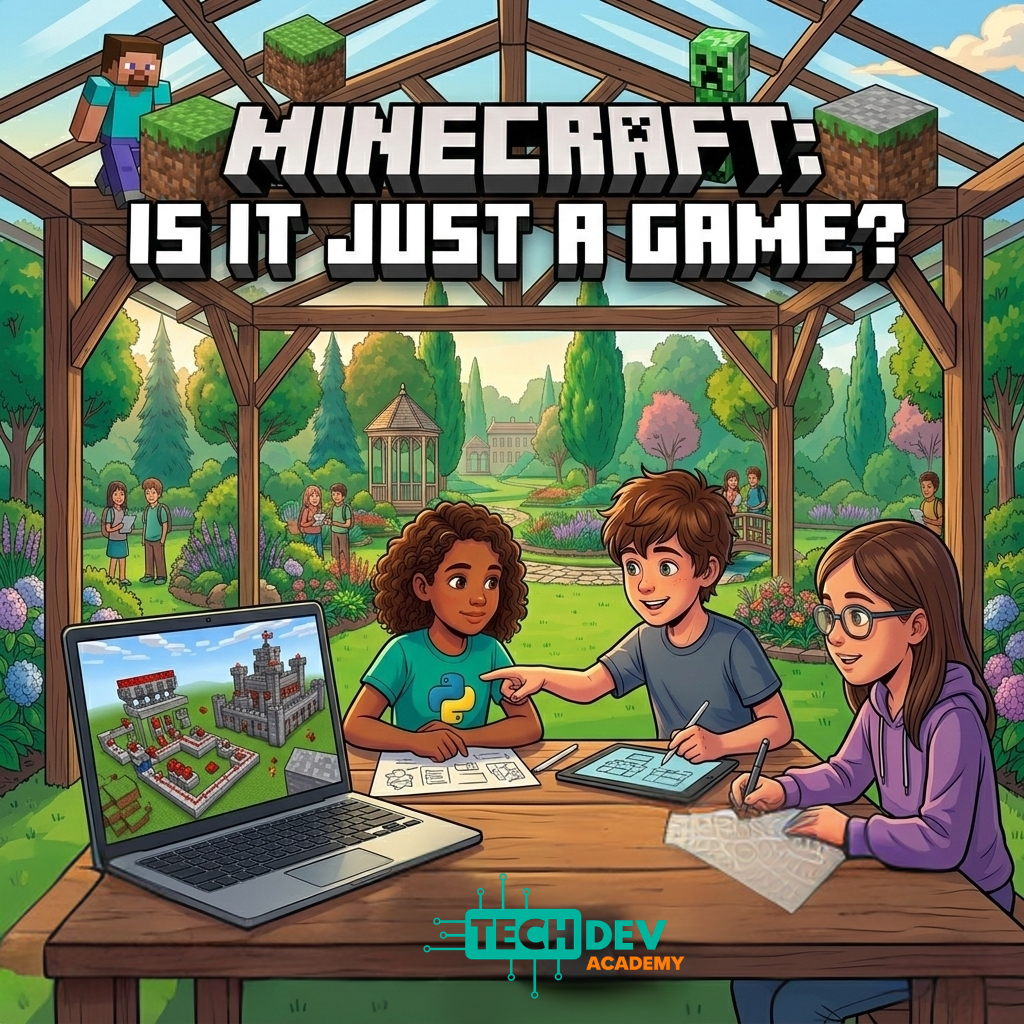
If your child spends hours in Minecraft, you’re probably wondering: is this actually time well spent? The short answer is yes — but the details matter. In fact, research on game-based learning suggests that open-ended, creative games can support key cognitive skills. Moreover, Minecraft stands out because it’s not a traditional video game. Instead, it’s a digital sandbox where children build, experiment, and solve problems on their own terms.
In this guide, we break down exactly how Minecraft supports learning — and how parents can make the most of it.
What Makes Minecraft Different From Other Games
Most video games guide players through a fixed story or set of levels. In contrast, Minecraft does the opposite. There are no instructions, no single correct path, and no end goal. Instead, players decide what to build, explore, or create.
This open structure means children must:
- Set their own goals and plan ahead
- Experiment and learn from failure
- Think spatially and logically
- Collaborate with other players in shared worlds
For many children, Minecraft becomes their first experience with digital creativity — and a gateway to systems thinking.
Is Minecraft Educational? 4 Ways It Supports Learning
1. Creativity and Spatial Thinking
Children regularly recreate famous landmarks, design fantasy environments, or build entire functional cities in Minecraft. As a result, these projects aren’t just fun — they require planning, material management, and spatial reasoning. In addition, these skills closely mirror those used in architecture and engineering design.
2. Problem-Solving and Logical Thinking
Minecraft constantly presents players with challenges: managing limited resources, designing efficient structures, or getting an automated system to work. Since there’s no walkthrough, children must troubleshoot and iterate. As a result, this trial-and-error process builds persistence and logical reasoning — skills that transfer well beyond the game.
3. Collaboration and Communication
Multiplayer Minecraft is a surprisingly powerful environment for social learning. For example, children divide tasks, exchange ideas, negotiate decisions, and work toward a shared goal. Furthermore, unlike competitive games, many Minecraft experiences revolve entirely around building something together — making teamwork the point, not a side effect.
4. Early Coding Concepts Through Redstone
Minecraft’s Redstone system lets players build logic-based mechanisms that function like real electrical circuits. In other words, children who design Redstone contraptions are, without realizing it, learning about cause-and-effect, automation, and conditional logic — all foundational concepts in programming. Moreover, according to Microsoft’s Minecraft Education platform, the game is actively used in thousands of classrooms worldwide to teach STEM subjects.
If your child’s interest in Redstone sparks a broader curiosity, check out our guide on the best coding languages for kids. You may also enjoy our overview of game development for kids — a natural next step for children who love building in Minecraft.
When Does Minecraft Become Most Educational?
The key variable is how your child plays. For instance, passive or repetitive play offers less benefit. However, when children take on creative, goal-driven projects, Minecraft starts to function less like a game and more like a digital construction space.
High-value activities include:
- Building cities or large-scale architectural projects
- Recreating real-world or historical landmarks
- Designing functional Redstone systems
- Collaborating on shared creative builds with peers
- Using Minecraft Education Edition for curriculum-linked projects
Tips for Parents: Supporting Healthy Minecraft Habits
Like any screen activity, Minecraft works best as part of a balanced routine. Therefore, here’s how to keep it productive:
- Ask your child to show you what they’re building — genuine curiosity makes play more meaningful
- Encourage project-based goals instead of open-ended sessions
- Balance screen time with offline creative activities
- Explore Minecraft Education Edition, which offers teacher-designed lessons in STEM, history, and more
- Use parental controls to manage multiplayer settings and screen time limits
Frequently Asked Questions
Is Minecraft educational for kids? Yes. Minecraft supports creativity, spatial thinking, problem-solving, collaboration, and early logic skills. It’s used in thousands of classrooms globally through Minecraft Education Edition and is widely recognized by educators as a tool for project-based learning.
What age is Minecraft appropriate for? Most children start playing Minecraft between ages 6 and 8. The game has a PEGI 7 rating (E10+ in the US), making it suitable for primary school age. Younger children may benefit from parent co-play to get started.
Can Minecraft help kids learn coding? Indirectly, yes. Minecraft’s Redstone system introduces concepts like logic gates, automation, and conditional thinking — all core to programming. In addition, Minecraft Education Edition also includes Hour of Code activities built around Python and block-based coding, making it an even more direct path to learning.
Is Minecraft safe for children? Minecraft can be safe when played in private worlds or moderated servers. Parents can use the Family settings in the Microsoft account to control who children play with, limit chat, and manage screen time. The game does not contain graphic violence, though some survival mode elements may be too intense for very young players.
Does Minecraft have an educational version? Yes. Minecraft Education Edition is a dedicated platform for schools, with lesson plans, teacher tools, and curriculum-aligned content covering subjects from mathematics and science to history and digital citizenship.